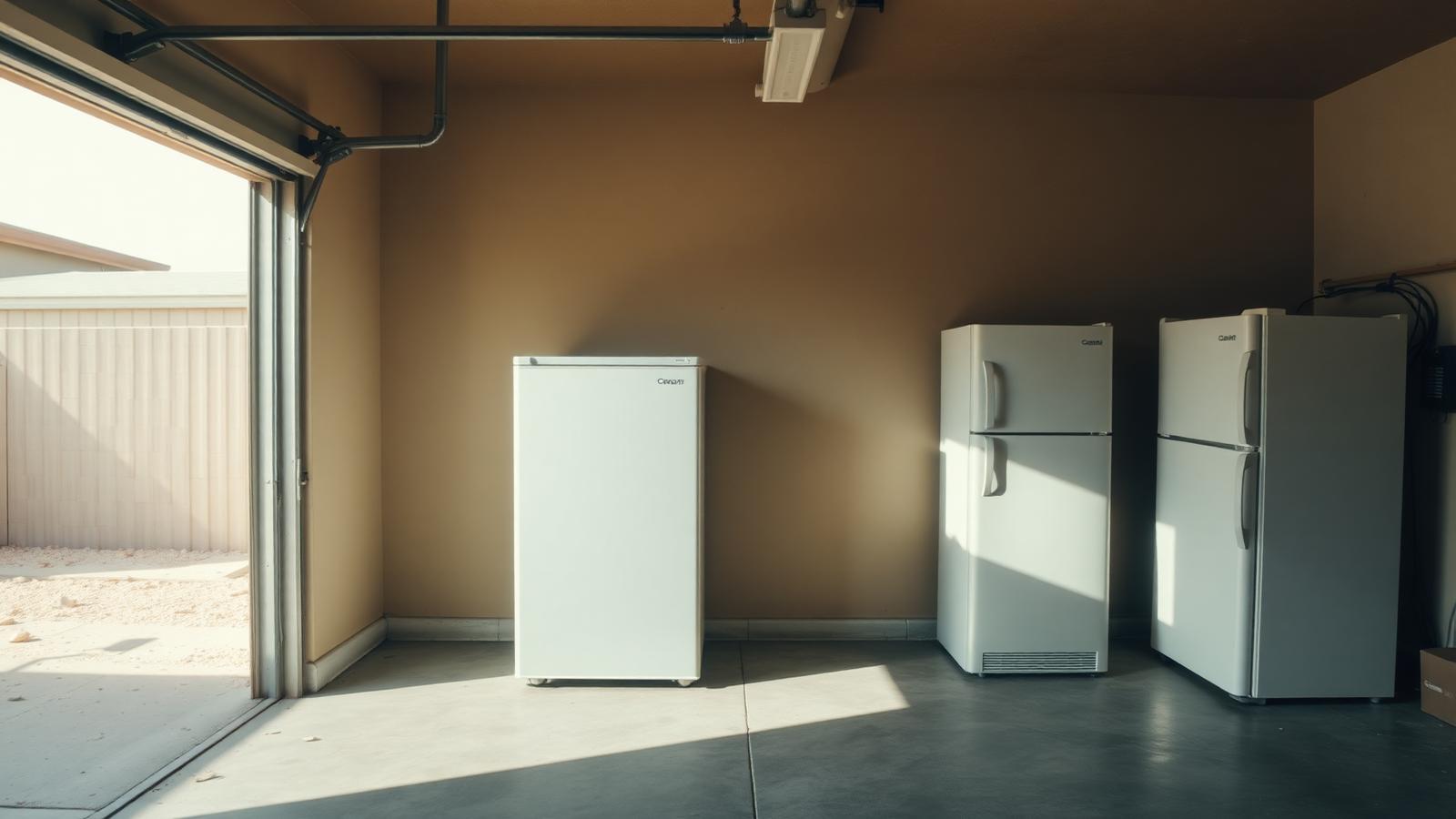
Why standard fridges die in St. George garages
A refrigerator pulls heat out of its inside and dumps it into the room around it. When that room is 120°F, the appliance can't shed heat fast enough. The compressor runs constantly, the condenser fan can't keep up, and internal temperatures climb. Three things happen in sequence:
- Compressor runs 24/7 instead of cycling on/off → much higher electric bill
- Internal temperature rises → food in the fresh section warms up, freezer thaws
- Sustained max-load operation → compressor or sealed system fails years early
Quick test
"Garage-ready" — what it actually means
Garage-ready refrigerators and freezers have wider ambient temperature ranges (often 38–110°F or 0–110°F) and dual thermostats or extra insulation to handle bigger swings. They're not magic — they still need ventilation, shade, and clean coils — but they're designed to survive Southern Utah summers in a way standard fridges aren't.
Look for labels like "Garage Ready," "Convertible," or specific ambient temperature ratings on the spec sheet. Brands with strong garage-ready lines include GE Garage Ready, Frigidaire Gallery, Whirlpool, and Gladiator. Most luxury and built-in fridges are NOT garage-rated — don't move a Sub-Zero into the garage.
What survives a Southern Utah summer, what doesn't
Likely to die early in a hot garage
- Older standard refrigerators (10+ years, wide-range ambient never specified)
- Compact apartment fridges
- Wine coolers without outdoor or extended-range ratings
- Standalone freezers without dual-thermostat or garage-ready labels
- Any built-in or luxury fridge — these belong inside
Likely to survive (with care)
- Garage-ready chest and upright freezers
- Garage-rated refrigerators with proper clearance
- Outdoor-rated beverage centers and ice makers (in shade)
- Modern fridges with explicit 110°F+ ambient ratings
Laundry rooms and hot dryers
Hot Southern Utah laundry rooms have their own problem: dryers struggle to dump heat into already-hot rooms, dry times climb, and dryers overheat. Most homes vent dryers outside, but a partially blocked vent in a 105°F laundry room can push internal dryer temperatures past safe operating limits — exactly where dryer fires start.
Annual dryer vent cleaning is more important here than almost anywhere else. Dryer vent cleaning in Southern Utah →
- Annual vent cleaning is the highest-ROI laundry maintenance you can do
- Pull dryer out and vacuum behind it every 6 months
- Check that the laundry room itself gets some airflow — a closed-door 105°F room is hard on every appliance
- Don't run dryer back-to-back loads in mid-afternoon during peak summer if you can avoid it
Outdoor kitchens in Southern Utah
Outdoor refrigerators, beverage centers, ice makers, and vent hoods in St. George, Hurricane, and Bloomington Hills backyards live one of the hardest appliance lives in the country. Sun, heat, hard water, dust, and heavy weekend use all stack up. The single best investment for outdoor appliance life is shade. A pergola, eave overhang, or shade sail moves an outdoor fridge from "operating at its absolute limit" to "operating within spec."
Other essentials:
- Outdoor-RATED appliances only — indoor models will not survive
- Vacuum condenser coils every 3 months (more in dusty areas)
- Run drain cycles on outdoor ice makers per the manufacturer schedule
- Cover units during snowbird off-season — even short winter rains hurt unprotected electronics
- Replace UV-degraded door seals before they leak cold air all summer
Outdoor kitchen appliance repair →
Hot-weather maintenance checklist
- Vacuum condenser coils on every fridge/freezer every 3 months (every month for garage units)
- Give garage and outdoor fridges at least 4 inches of clearance on all sides for airflow
- Move appliances away from west-facing walls if possible
- Add a small thermostat-controlled exhaust fan to your garage if you keep appliances out there
- Check door seals — a worn gasket on a garage fridge in 115°F is a slow disaster
- Replace water filters more often during summer — they get hit harder
- Watch your electric bill in July/August — a sudden jump often means an appliance is running constantly
- Listen for changes in compressor noise — louder or constant running is the first warning sign
Repair vs replace decision
Here's the honest version we'd tell a friend:
- Standard fridge, 10+ years old, struggling annually in a hot garage → replace with garage-ready
- Garage-ready unit with a specific failed part (fan, thermostat, control board) → repair
- Any built-in or luxury fridge moved to a hot garage → move it back inside, replace with garage-ready for the garage
- Outdoor appliance failing repeatedly in a sun-exposed install → add shade BEFORE repairing or replacing
- Ice maker producing slow or hollow ice every summer → diagnose and clean before assuming it's dead
When you're not sure, that's what the diagnostic call is for. We'd rather tell you to replace than charge you for a repair that won't last another summer.
Refrigerator repair in Southern Utah → · Freezer repair →
FAQ
How hot does a garage get in St. George?
Uninsulated, west-facing, single-car garages in St. George commonly hit 110–125°F on July afternoons. Most standard refrigerators are rated for ambient temperatures of 55–95°F, so they're operating well outside spec for months at a time. Even garage-ready models have ambient temperature limits.
Will any refrigerator work in a Southern Utah garage?
Only refrigerators labeled 'garage-ready' or 'extreme temperature' (sometimes 110°F or 115°F upper rating). Standard fridges may run but will struggle, cycle constantly, lose efficiency, and fail earlier. Even garage-ready units last longer with shade, ventilation, and clean condenser coils.
Why does my garage freezer thaw in summer but work fine in winter?
When ambient temperature drops below the freezer's thermostat set point, the compressor stops cycling, the freezer warms, and food thaws. In Southern Utah this is usually a summer problem the opposite direction — heat overwhelms the unit. Either way, a garage-ready or dual-thermostat unit is the fix.
Do outdoor kitchen appliances really survive Southern Utah heat?
Outdoor-rated appliances handle higher ambient temperatures than indoor units, but they still need shade, ventilation, and regular condenser coil cleaning. An outdoor ice maker in direct sun on a 115°F afternoon is operating at its absolute limit and will struggle. Shade extends life dramatically.
What can I do without buying a new appliance?
A lot. Vacuum the condenser coils every 3 months, give the unit 4+ inches of clearance for airflow, add a shade or move it away from a west-facing wall, install a small ventilation fan in the garage, and check door seals. These changes alone often add years to garage appliance life in St. George.
Is it cheaper to repair or replace a struggling garage fridge?
Depends on age, brand, and what's failed. A standard non-garage-ready fridge that's struggling annually may be cheaper to replace with a true garage-ready unit. A garage-ready unit with a failed component is usually worth repairing. We'll give you an honest answer after the diagnostic.
Garage fridge or freezer struggling already?
We diagnose hot-weather appliance failures every week across St. George, Cedar City, Hurricane, and Mesquite. We'll tell you whether to repair or replace — honestly.
Call (435) 674-1702